【中文摘要】西北工业大学仿生系统芯片交叉研究中心论文TSCA于2026年9月15日被IEEE TVLSI录用为Regular Paper。第一作者为博士生Musheer Abdullah,通讯作者为高武教授。针对脉冲CNN边缘推理各阶段负载差异大、传统同构加速器存在冗余计算和膜状态存储开销高等问题,TSCA采用三元/8位/二值异构多精度架构,包含TCE、STCE和DBC三个专用引擎,并集成5-bit QIF神经元,使膜状态存储降低达75%,精度损失小于0.7个百分点。该处理器在Xilinx Zynq UltraScale+ FPGA上以250 MHz运行,峰值吞吐5.68 TOPS,MNIST/CIFAR-10/CIFAR-100能效分别为1498/629.8/281.4 FPS/W,且不使用DSP。成果表明,精度感知的架构专门化可有效平衡资源、功耗与性能,面向端到端神经形态边缘推理与近传感智能视觉。
《IEEE超大规模集成电路(VLSI)系统汇刊》(TVLSI)是IEEE于1993年创办的权威月刊,涵盖VLSI/ULSI系统设计、验证、测试与实现,涉及所有抽象层次。主题包括系统架构、FPGA、高速互连、神经网络和混合信号系统。其2025年影响因子为3.2,JCR Q2、中科院2区。首次决定中位时间约7.8周,录用率约28%–31%。订阅模式发表不收APC,但收取超页费;开放获取约2800美元。TVLSI是芯片设计、EDA和VLSI架构研究的重要投稿期刊。
Lab News — A paper titled “TSCA: A Heterogeneous Multi-Precision Spiking CNN Processor with Low-Bit Neuron Dynamics for Edge Inference,” has been accepted as a Regular Paper in IEEE Transactions on Very Large Scale Integration (VLSI) Systems (TVLSI), on Sept. 15th , 2026. The first author of the paper is PhD student Musheer Abdullah, and the corresponding author is Prof. Wu Gao. All authors are with the Interdisciplinary Research Center for Bio-inspired System-on-Chip, Northwestern Polytechnical University.
Why spiking CNNs need a smarter chip
Spiking neural networks are attractive for edge AI because they use sparse binary spikes—like the brain. But a full spiking CNN pipeline has very different jobs: input encoding, deep feature extraction, and classification.
Conventional accelerators often handle these stages with a similar architecture, causing redundant temporal computation, unnecessary neuron updates, and high membrane-state storage overhead.
TSCA takes a different approach: give each stage the precision and hardware it needs.
Three engines, three jobs
TSCA combines ternary, 8-bit, and binary computation with low-bit neuron dynamics. Its three specialized engines are:
Ternary Convolution Encoder (TCE): handles the first convolution directly on input pixels using ternary weights and generates spikes in one pass.
Spatiotemporal Computing Engine (STCE): accelerates deeper SCNN layers with high parallelism across channels, kernels, and 2D spatial neurons, integrating a 5-bit Quantized Integrate-and-Fire (QIF) neuron model.
Dual-Binary Classifier (DBC): performs on-processor classification using binary spikes and binary weights, with adaptive average pooling fused into synaptic computation.
These stages are connected through a reconfigurable data-flow orchestrator and executed in a pipelined manner.
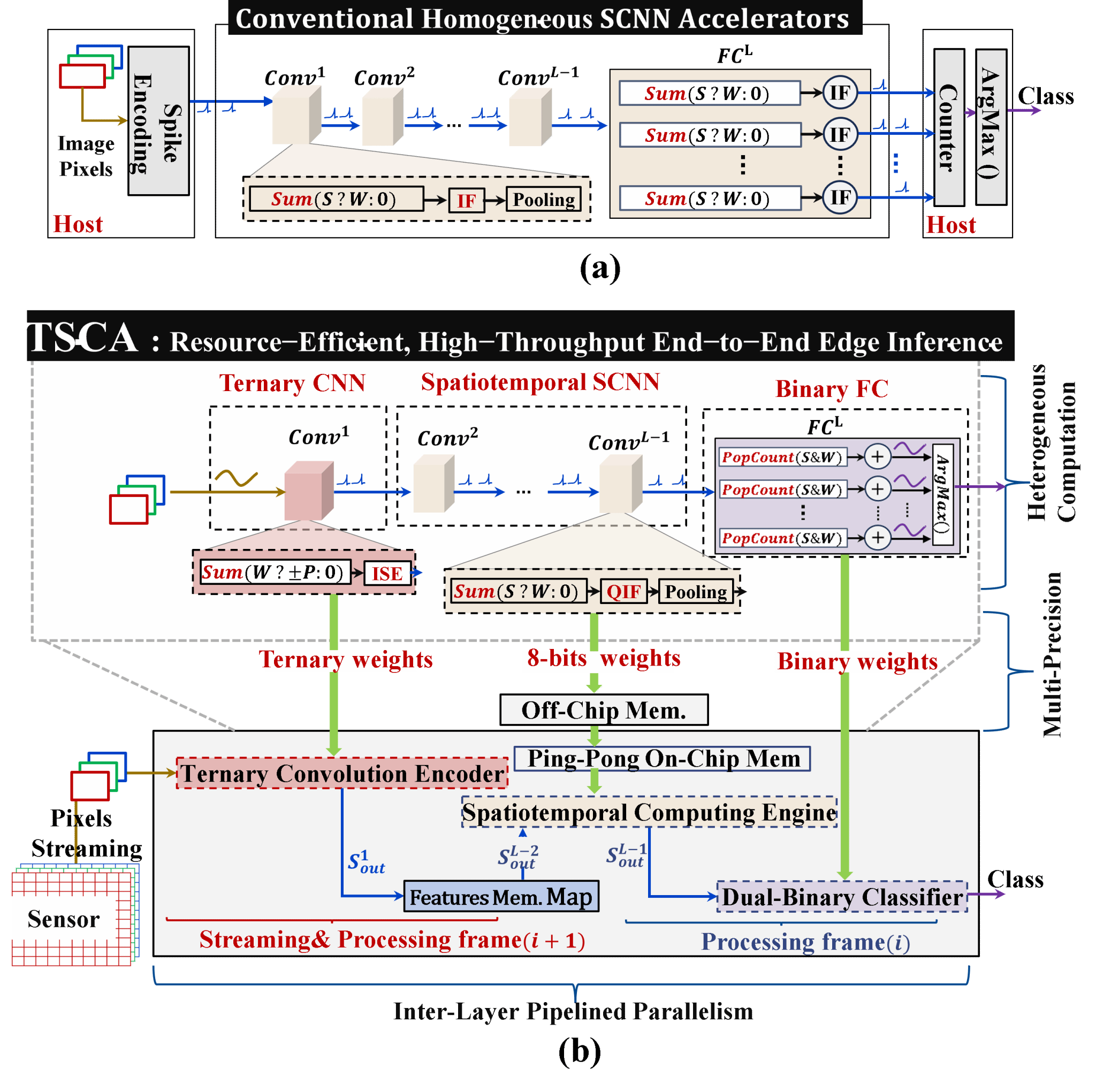
Fig.1 TSCA replaces conventional homogeneous SCNN processing with a stage-specialized TCE-STCE-DBC pipeline and inter-layer parallelism.
The clever trick: 5-bit neurons
A key contribution is the low-bit QIF neuron. Compared with full-precision integrate-and-fire neurons, the 5-bit representation reduces membrane-state storage by up to 75% while adding less than 0.7 percentage points of accuracy loss.
In simple terms: the neuron’s short-term memory is compressed dramatically, but the network still remembers enough to get the answer right.
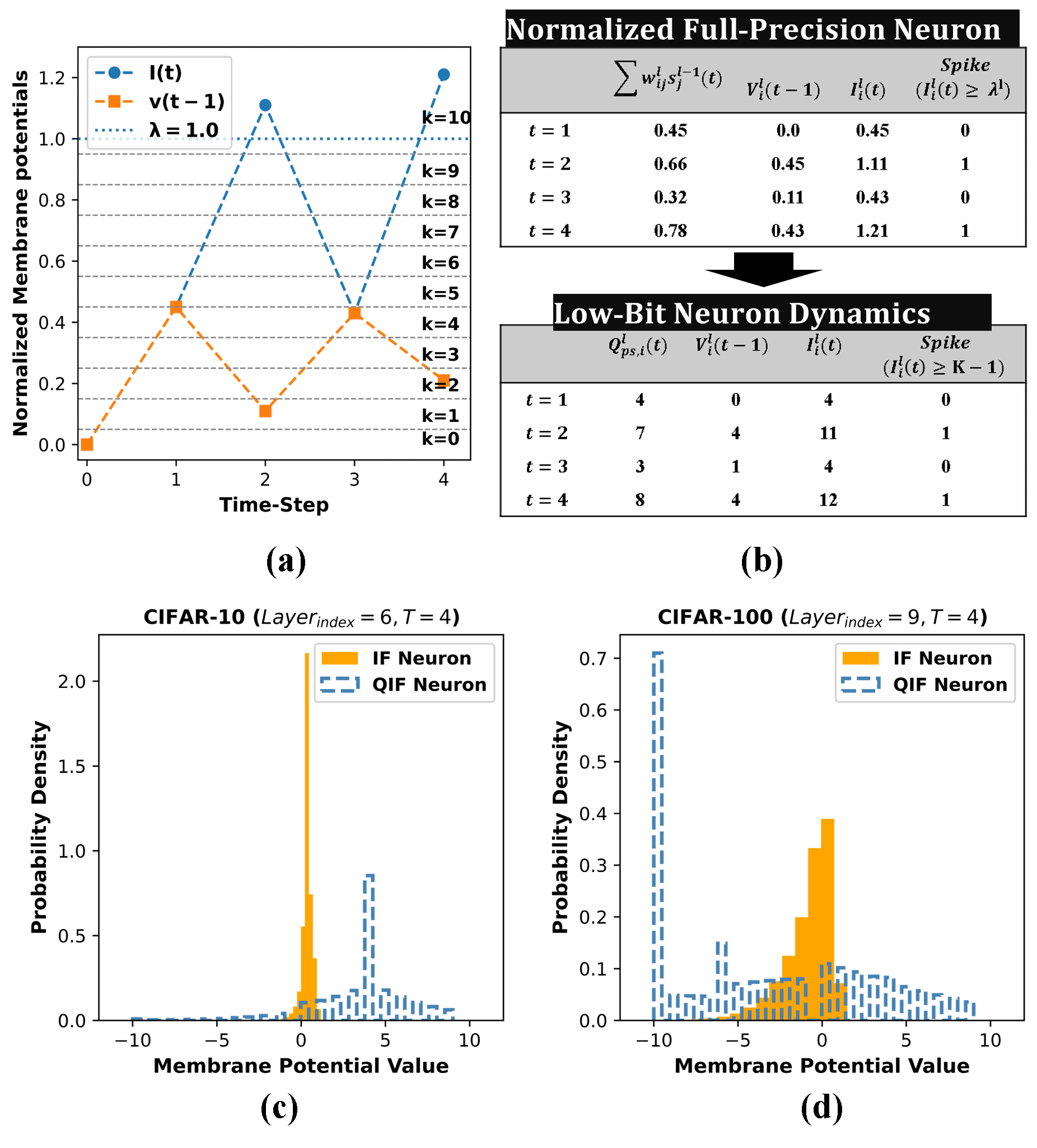
Fig.2 Proposed low-bit QIF neuron dynamics and representative full-precision versus quantized membrane-potential distributions.
Performance overview
Implemented on a Xilinx Zynq UltraScale+ FPGA at 250 MHz:
Peak throughput: 5.68 TOP/s
Energy efficiency: 1498 FPS/W on MNIST, 629.8 on CIFAR-10, 281.4 on CIFAR-100
DSP blocks used: none
Using no DSP blocks matters for embedded platforms, where dedicated arithmetic resources can limit scalability.
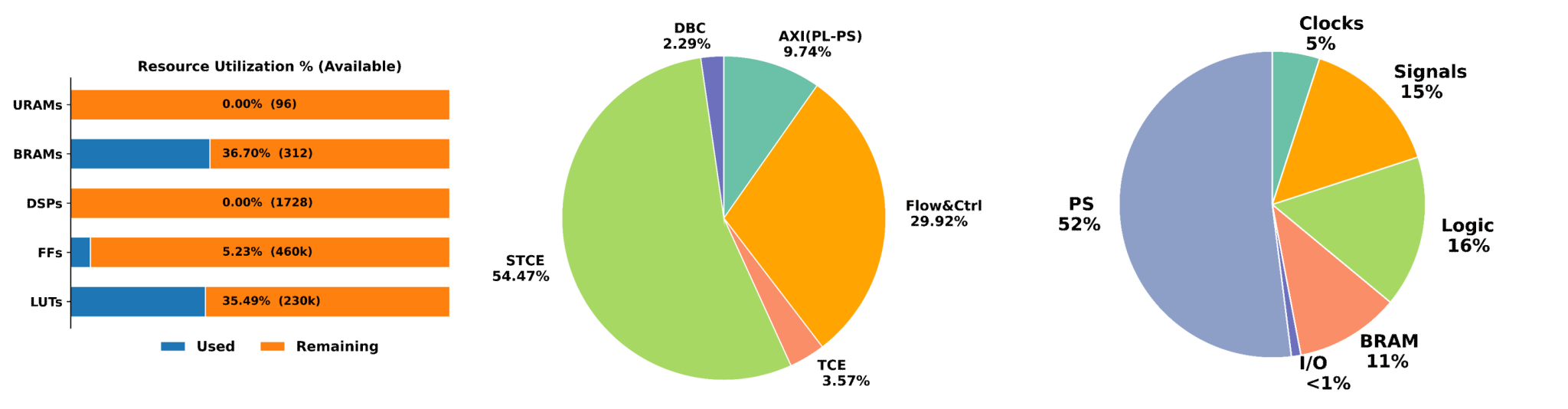
Fig.3 TSCA implementation results: FPGA resource utilization, module-level resource contribution, and power breakdown.
Why it matters
TSCA shows that precision-aware architectural specialization can balance resources, power, and performance for end-to-end neuromorphic edge inference. It also points toward future near- and in-sensor intelligent vision systems—where computation moves closer to the sensor and efficiency is designed in from the start.
About IEEE TVLSI
IEEE Transactions on Very Large Scale Integration (VLSI) Systems (TVLSI) is a leading monthly IEEE journal founded in 1993. It covers VLSI/ULSI system design, verification, testing, and implementation across all abstraction levels. Topics include system architecture, FPGAs, high-speed interconnects, neural networks, and mixed-signal systems. Its 2025 impact factor is 3.2, Q2 in JCR and CAS Category 2. Median first decision is about 7.8 weeks; acceptance is roughly 28–31%. Subscription publication has no APC but charges overlength fees; open access costs about US$2,800. TVLSI is a key venue for chip design, EDA, and VLSI architecture research.